

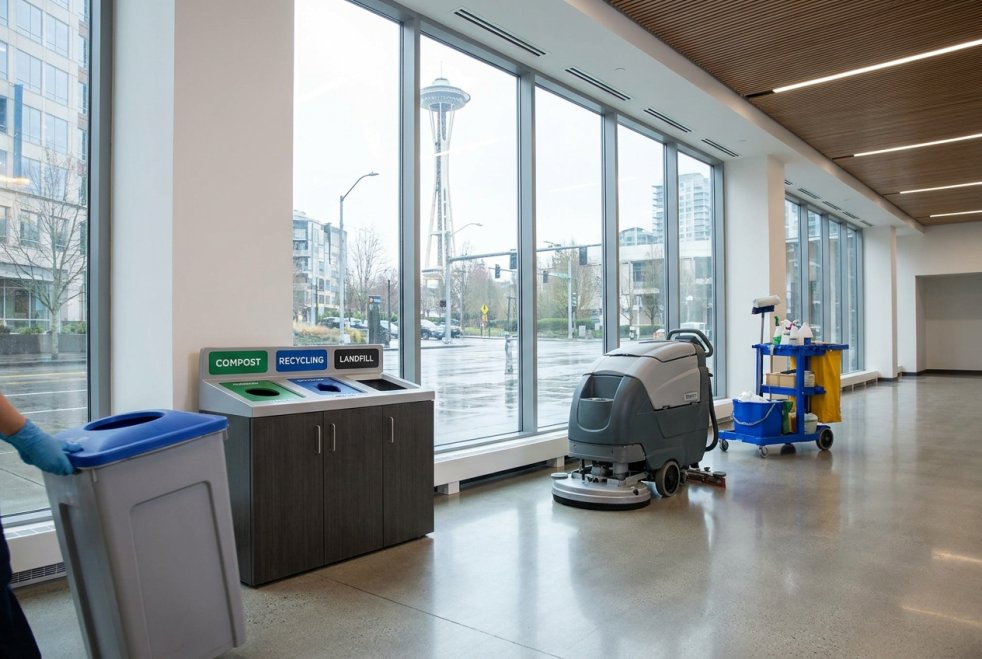
Beyond Trash Removal: The Role of Waste Management in Facility Services in Seattle
Most facility managers think of waste management as a simple task: empty the bins, replace the liners, move on. But in a commercial building, how waste is handled affects sanitation, pest pressure, odor control, and even regulatory compliance.
In Seattle and the greater Puget Sound region, the local climate adds another layer of complexity that a basic trash removal schedule rarely accounts for.
What Waste Management Actually Involves in a Commercial Facility
Waste management in a professional facility setting covers far more than pulling bags from cans. A complete program addresses every point where waste is generated, stored, or removed.
- Liner changes on a schedule matched to waste volume and type, not just a fixed day of the week
- Bin sanitation to remove residue, odor, and bacteria that build up inside containers over time
- Separation of recyclables and landfill waste in compliance with Seattle's strict municipal requirements
- Staging and transport of waste to exterior collection points without contaminating corridors or common areas
- Monitoring of high-volume areas like break rooms, restrooms, and loading docks for overflow before it becomes a problem
When any one of these steps is inconsistent, the effects show up quickly in odors, pests, and compliance gaps.
How Seattle's Climate Makes Waste Management More Demanding
Seattle averages over 37 inches of rain annually, and the region stays cool and damp for most of the year. Those conditions directly affect how waste behaves inside and around commercial buildings.
- Cool, moist air slows evaporation inside bins, allowing food waste and organic material to stay wet longer and generate stronger odors
- High ambient humidity encourages mold growth on bin surfaces and in the areas surrounding waste receptacles
- Outdoor dumpster areas stay wet for extended periods, creating conditions that attract pests and produce runoff near building entries
- Composting waste, which Seattle businesses are required to separate, breaks down faster in damp conditions and needs more frequent removal to avoid odor buildup
A waste management schedule built for a dry climate will fall short in the Pacific Northwest. Frequency and product selection both need to reflect actual regional conditions.
Seattle's Waste Separation Rules Add Compliance Pressure
Seattle has some of the most detailed commercial waste separation requirements in the country. Businesses are required to separate food scraps, recyclables, and landfill waste, and failure to comply can result in fines from Seattle Public Utilities.
- Food waste must be kept separate from landfill trash and placed in designated compost containers
- Contaminated recyclables, such as food-soiled paper or plastic, are rejected and must go to a landfill instead
- Employees who are not trained on separation requirements will mix waste streams, creating compliance exposure for the business
- Exterior containers that are not properly labeled or positioned can result in service refusals from the hauler
A professional cleaning and waste management program includes the setup, labeling, and staff-facing guidance that keeps your facility in compliance without putting that burden on your team.
Warning Signs Your Waste Program Is Falling Behind
Waste management problems rarely announce themselves all at once. They develop gradually until they become visible or noticeable to clients and staff. Watch for these indicators.
- Persistent odors in break rooms or near restrooms that return within hours of cleaning
- Bins that are overflowing before the scheduled service visit
- Visible residue or staining inside waste containers that is not being addressed between liner changes
- Fruit flies, ants, or rodent activity near waste staging areas or dumpster enclosures
- Complaints from employees about the smell or appearance of common areas
- Mixed waste streams that have resulted in rejected pickups or hauler notices
Each of these is a signal that the current program is not matched to the actual demand of your facility.
What a Professional Waste Management Program Looks Like
A well-structured program is proactive, not reactive. It is built around the specific layout, occupancy, and waste volume of your building, adjusted for Seattle's climate and compliance requirements.
- Service frequency is set by actual waste generation, not a generic schedule
- Bin sanitation is performed on a regular rotation, not only when odor complaints arise
- Compost, recycling, and landfill containers are properly labeled and positioned throughout the facility
- Break rooms and restrooms receive more frequent attention during high-occupancy periods
- Exterior waste areas are inspected and maintained to prevent pest access and drainage issues
System4 of Washington builds waste management into its broader commercial cleaning programs so that every part of your facility is covered under one consistent service plan.
What to Do Next
If your current cleaning program treats waste removal as an afterthought, it is worth reviewing what that gap is actually costing you in odors, pest risk, and compliance exposure.
- Walk through your break rooms, restrooms, and waste staging areas and note any odors, overflow, or residue
- Check whether your waste containers are correctly labeled for Seattle's compost, recycling, and landfill requirements
- Ask whether your current provider is sanitizing bins or only replacing liners
- Consider whether your service frequency matches your actual occupancy and waste volume
Call (253) 215-8899 today to schedule a walkthrough and find out how a complete waste management program can protect your Seattle facility from the ground up.


