

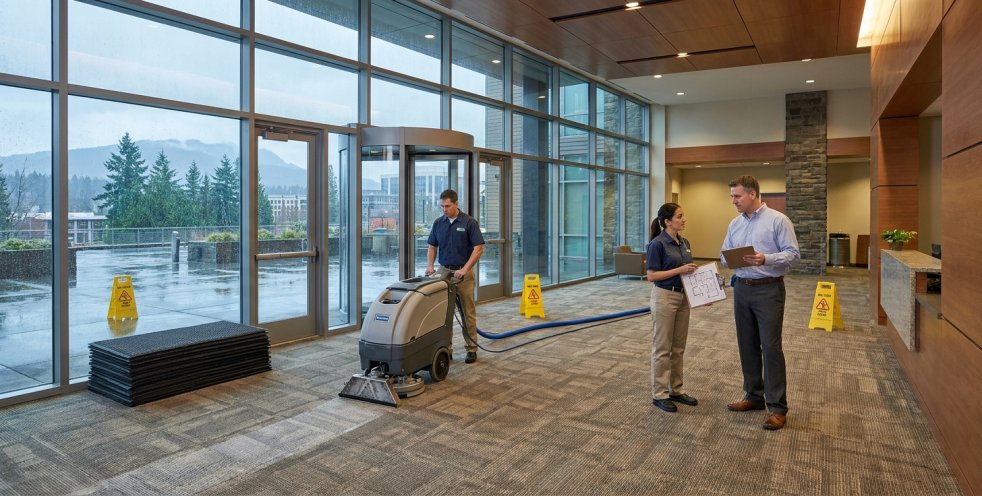
Carpet Care at Scale: How Facility Managers Coordinate Specialized Services
Carpet maintenance in a large commercial facility is not a single task. It is a coordinated effort that involves multiple service types, scheduled around occupancy, traffic patterns, and the specific demands of the Seattle climate.
Facility managers who treat carpet care as a once-in-a-while deep clean tend to spend more money on early replacement than those who build a structured program from the start.
Why Commercial Carpet Wears Faster Than You Expect
High-traffic commercial carpet faces a different category of stress than residential flooring. The combination of foot traffic, soiling, and moisture creates compounding damage that is not always visible until it is already advanced.
- Dry soil and grit grind into carpet fibers with every footstep, cutting the fibers from the inside out over time
- Moisture tracked in from Seattle's rainy season keeps carpet damp longer, encouraging mold and mildew growth in the backing and pad
- Oils from foot traffic and food spills bond to fibers and attract more soil, creating a cycle that routine vacuuming cannot break
- High-traffic lanes near entries, corridors, and elevator lobbies deteriorate significantly faster than the surrounding areas
Understanding these causes is the first step toward building a service schedule that actually protects the investment.
Seattle's Climate Creates Specific Carpet Challenges
The Pacific Northwest receives consistent rainfall from October through May, and Seattle's mild, damp winters mean wet shoes and boots are tracked through commercial buildings for months at a time. That moisture does not evaporate quickly in a low-sunlight, high-humidity environment.
- Wet carpet near building entries stays damp for extended periods, creating ideal conditions for mold growth in the carpet backing
- Persistent humidity slows drying after extraction cleaning, requiring careful scheduling and airflow management to prevent re-soiling and odor
- Muddy and debris-heavy soiling from outdoor conditions is harder to remove than dry dust and requires more aggressive extraction methods
- Entry mats that are not serviced frequently enough become saturated and push moisture further into the building, rather than stopping it at the door
A carpet care program in Seattle needs to account for these conditions directly, not just follow a generic national maintenance calendar.
Warning Signs Your Carpet Program Is Falling Behind
Carpet problems build gradually. By the time they are visible to clients or tenants, the damage has usually been accumulating for weeks. Watch for these indicators.
- Matted or flattened fibers in traffic lanes that do not recover after vacuuming
- A musty or stale odor in carpeted areas, especially near entries and break rooms
- Visible staining that returns after spot cleaning, which often signals wicking from the carpet backing
- Discoloration along baseboards or in corners where moisture has been sitting undetected
- Tenant or employee complaints about odors or appearance in common areas
Each of these signals that the current maintenance frequency or method is not matched to the actual demands of the space.
The Layered Approach to Commercial Carpet Care
Effective carpet maintenance at scale is not one service. It is a layered program that combines daily maintenance with periodic specialized treatments, coordinated around your facility's schedule and occupancy.
- Daily or nightly vacuuming with commercial-grade equipment to remove dry soil before it bonds to fibers
- Interim cleaning methods, such as encapsulation or bonnet cleaning, are used to maintain the appearance between deep extractions
- Hot water extraction on a scheduled cycle, typically two to four times per year, depending on traffic, to remove embedded soil and restore fiber condition
- Spot treatment protocols so that spills are addressed immediately rather than left to set
- Entry mat service and rotation to reduce how much moisture and soil reach the carpet in the first place
Each layer serves a different purpose. Skipping any one of them puts more pressure on the others and shortens the life of the carpet overall.
How Facility Managers Coordinate Specialized Services Effectively
Coordinating carpet care across a large facility requires planning around access, occupancy, and drying time. Scheduling extraction cleaning during low-traffic windows, such as evenings or weekends, reduces disruption and allows adequate drying before the space is back in use.
- Map your facility by traffic zone and assign service frequency based on actual use, not square footage alone
- Build extraction cleaning into the facility calendar at the start of each year so it does not get deferred when budgets tighten
- Coordinate with your cleaning provider on drying time requirements, especially in Seattle's wetter months when airflow matters more
- Keep a log of spot treatments and recurring stain locations to identify problem areas before they require costly remediation
- Review entry mat placement and condition at the start of each rainy season to ensure they are doing their job
System4 of Washington works with facility managers across the Seattle area to build carpet care programs that match the real demands of their buildings, including the moisture and soiling challenges that come with the Pacific Northwest climate.
What to Do Next
If your current carpet maintenance program is reactive rather than scheduled, it is worth reviewing what that approach is costing you in premature wear, tenant complaints, and unplanned deep cleaning expenses.
- Walk your facility and identify the highest-traffic zones, entry points, and any areas showing early signs of wear or odor
- Review how often extraction cleaning is currently scheduled and whether that frequency reflects Seattle's rainy season demands
- Ask whether your current provider is using interim cleaning methods between extractions or relying on vacuuming alone
- Check your entry mat program and confirm mats are being serviced, not just left in place
Call (253) 215-8899 today to schedule a walkthrough and find out how a structured, layered carpet care program can extend the life of your flooring and keep your Seattle facility looking its best year-round.


